التاريخ
Travel guide
The Reconquista
The Reconquista
For generations, the whole of Spanish medieval history was compressed into a single word: the Reconquista — a 770-year Christian holy war to "reconquer" the peninsula from Islam, running from 722 to the fall of Granada in 1492. It is a powerful story. It is also, historians increasingly agree, a misleading one. The reality, played out on the very frontier where Cortijo Bujio stands, was far messier — and far more interesting.

Here is the first surprise: medieval people did not talk about "the Reconquista." The term as we use it — one long, continuous, divinely ordained mission to restore Christian Spain — was crystallised and popularised much later, above all by 19th- and 20th-century nationalists who projected a single purpose backwards across eight centuries. It made a scattered, chaotic history feel like destiny. Under the Franco dictatorship it became almost official ideology, and even today it is invoked in political rhetoric across Europe.
Strip away the word and you find not one war but centuries of shifting frontiers, truces, alliances and betrayals that crossed the religious line constantly:
As the historian Brian Catlos argues, these encounters — cooperation and conflict alike — were driven by local agendas of power and survival, with religious justification usually added afterwards. Even the word "re-conquest" is loaded: it implies restoring something that had been lost, yet the small Christian kingdoms of the north were new states, and their long push south was as much colonisation and empire-building as any recovery.
None of this means faith never mattered. At certain moments it mattered enormously — and, tellingly, mostly late in the story. The puritanical Muslim Almoravids and Almohads from North Africa, and on the Christian side the ideology of crusade and the militant religious orders, injected genuine holy-war fervour into what had been a more pragmatic frontier. The decisive Christian victory at Las Navas de Tolosa (1212) and the final campaigns of the Catholic Monarchs, ending in 1492, were framed in explicitly religious terms. The "holy war" was real — but it was more the story's climax than its whole plot.
Nowhere shows the everyday truth better than the country around the villa. The castle-villages of Montefrío, Íllora and Moclín were not the front line of a clean crusade; they were a lived frontier of cattle-raids and ransoms, of merchants and spies, of truces made and broken, where people on both sides often had more in common with each other than with distant kings. That frontier finally fell in the campaign of 1486, six years before Granada itself. When you climb these ruins, you are standing in the real Reconquista — pragmatic, local and human — rather than the myth. (See our guides to the Granada frontier and El Cid.)
What was the Reconquista?
Traditionally, the centuries-long Christian conquest of Muslim Iberia, ending in 1492. Modern historians stress that the idea of a single, continuous religious "reconquest" was largely a later, nationalist construction laid over a much messier reality.
Did medieval people call it the Reconquista?
Not in the way we do. The unified concept was popularised mainly in the 19th and 20th centuries; the medieval frontier was a world of shifting, often cross-religious alliances.
Was it really a holy war?
At times, especially late — under the Almoravids and Almohads and during the crusading campaigns that ended in 1212 and 1492. For much of the period, though, pragmatism and self-interest outweighed religion.
Where can I see the real frontier near the villa?
The castle-villages of Montefrío (15 minutes), Íllora and Moclín — the actual medieval border, taken in 1486.
---
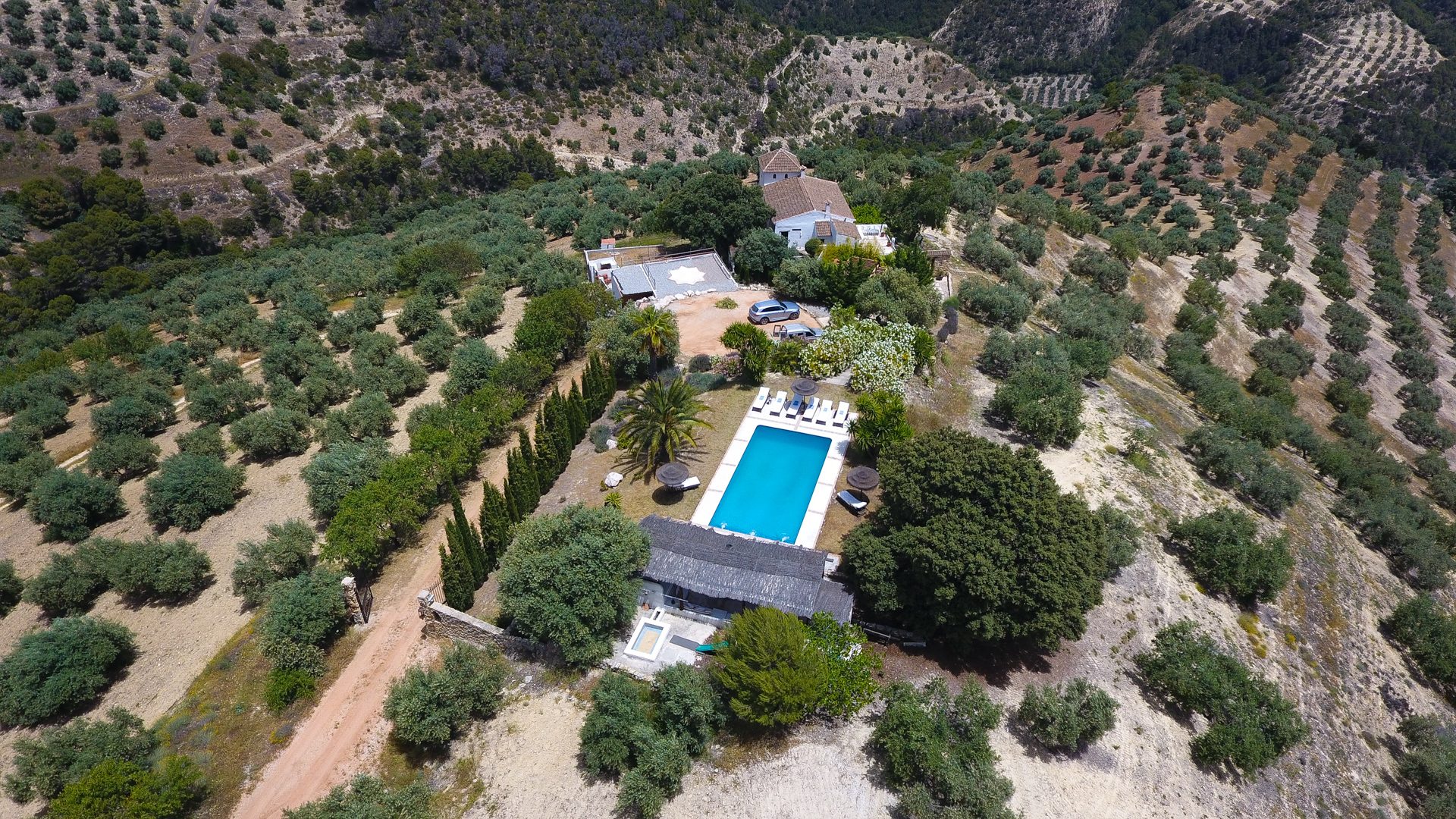
Cortijo Bujio sits on the old frontier itself. Read on about El Cid, the Granada frontier, convivencia — myth and reality and 1492.
Sources: Brian A. Catlos, Kingdoms of Faith; Richard Fletcher, Moorish Spain; Joseph F. O'Callaghan, Reconquest and Crusade in Medieval Spain