المناظر
Travel guide
Montefrío
Montefrío
Some places you have to explain. Montefrío you simply show. Round a bend on the approach and the whole village appears at once: a scatter of whitewashed houses spilling down a green valley, a castle-church balanced on a sheer rock at the top and a great round temple anchoring the town below. It is the view that made a small Andalusian village quietly famous the world over — and it is barely fifteen minutes from Cortijo Bujio. But the view is only the beginning. Montefrío is a place where a dog once changed church law, where a king carved crosses with his sword, where people were burying their dead before the pyramids were built and where a mountain village makes a cheese the whole world has judged the best. Here is the complete story.

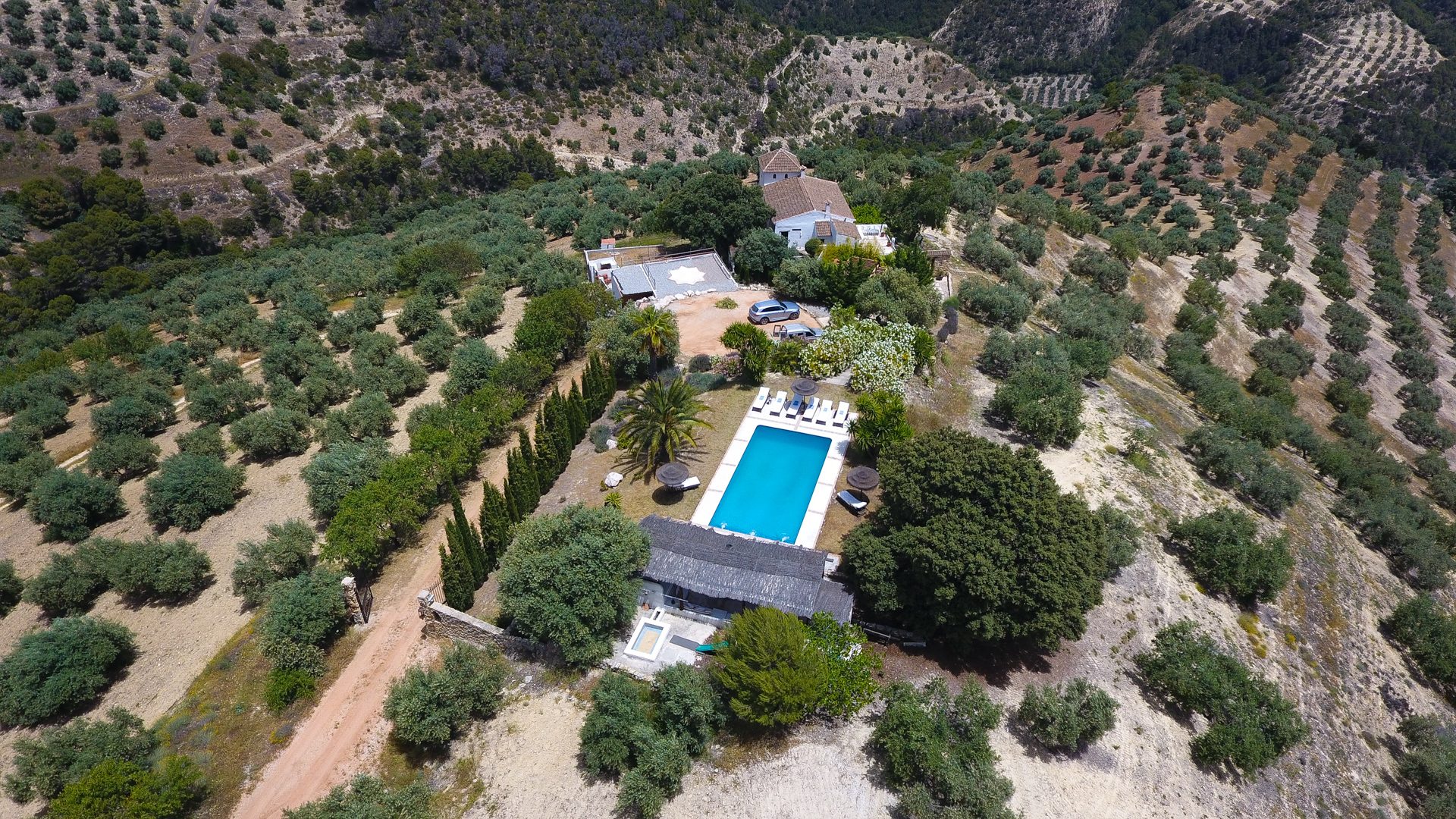
The name says where you are. Montefrío — monte frío, "the cold mountain" — sits high and clear on the northern edge of Granada province, its old quarter at around 834 metres, the ground rising behind it to the peak of the Sierra Parapanda at 1,604 m. This is the Poniente Granadino, a rolling country of olive groves, almond trees and holm oak, cooler and greener than the plains, where the light is sharp and the winters bite. Cortijo Bujio lies just above it, at 1,300 m, looking down on the whole scene.
In 2015, National Geographic named Montefrío one of the ten towns with the best views in the world — the only Andalusian village on the list, ranked fourth. It is also the only Andalusian village on the magazine's roundup of Spain's most beautiful medieval villages. The recognition stuck, and the town made it official: the lookout on the Tocón road, where that classic postcard image is taken, is now signposted as the Mirador de National Geographic. Go at the end of the day, when the low sun turns the white houses gold and throws the castle rock into silhouette. It is a five-minute drive from the centre and one of the great free experiences in the province.
Everything in Montefrío grew from that rock. The Nasrid castle that once crowned it was built in the mid-14th century — around 1352 — on the orders of Sultan Yusuf I of Granada, to shore up his kingdom's frontier after a catastrophic defeat: the Battle of Salado (1340) and the loss of the border towns of Alcalá la Real, Priego and Benamejí to Christian Castile in 1341. From 1352 until its fall, Montefrío was one of the key fortresses of the north-western Nasrid frontier, standing in a chain of signal towers with the castles of Íllora and Moclín, ready to flash the alarm towards Granada. It held for over 130 years — until the Christian campaign of 1486. (See our guide to the Granada frontier.)
Legend adds a flourish. When King Ferdinand took Montefrío in 1486, he is said to have inscribed crosses on the stonework of the first entrance bastion with his own sword — a conqueror's signature cut into the rock. Whether or not the great king really drew steel to score a cross, the story has been told here for five centuries.
After the conquest, the Christians did what they did across Al-Andalus: they built their faith on top of the old one. On the ruins of the Nasrid castle rose the Iglesia de la Villa (officially Santa María de la Encarnación), a late-Gothic church with Renaissance touches, its ashlar walls climbing straight out of the fortress rock. Its designer was no local mason but Diego de Siloé — the towering architect of Granada Cathedral — together with Jorge de Baeza; work continued until 1570. Today it houses the town's interpretation centre, and the climb up to it rewards you with a 360-degree panorama over the whole valley.
Here is the story that makes visitors laugh out loud. On 29 May 1776, the feast of Corpus Christi, the townspeople had gathered in the Iglesia de la Villa for Mass when a violent storm broke over the rock. Lightning struck the church roof, shattering the stained glass and sending great stones tumbling from the vault down onto the terrified congregation. Amid the chaos, one small dog — named Sultán — was caught by the strike and lost its tail. The town took the whole event as a kind of miracle of deliverance, and marked it forever after in the most charming way imaginable: every 29 May the Virgen de los Remedios is carried in procession — and, in memory of little Sultán, all dogs are allowed to enter the church that day. There are not many towns on earth where the law of the church was written by a dog.
Down in the town stands something you would never expect in a village this size: the Iglesia de la Encarnación, a completely circular church modelled on the Pantheon in Rome — the locals simply call it La Redonda, "the round one." Built between 1786 and 1802, in the reign of Charles III, it is considered one of the finest works of the Spanish Enlightenment. The project is attributed to Ventura Rodríguez, the leading Spanish architect of the age, and executed by Domingo Lois de Monteagudo. Its cylindrical drum is crowned by a dome nearly 28 metres across — by proud local reckoning the second-largest church dome in Spain. Step inside and the effect is extraordinary: a calm, luminous circle of space, almost austere, utterly unlike the gilded churches most visitors expect in the south.
Look closely and you'll find a small oddity the guides love to point out: the church's image of the Virgen de los Remedios holds the Christ child on her right arm, rather than the left, as was almost always the custom.
Five kilometres from town, in a hidden fold of grey limestone, lies one of Andalusia's most important prehistoric sites — and its name has a story too. The Peña de los Gitanos ("the Rock of the Gypsies") takes its name from the Roma families who long sheltered among its crags; but people were living here thousands of years before them. Occupation runs from the Early Neolithic, around 5300 BC, all the way to the 10th century AD — Neolithic caves, a necropolis of megalithic dolmens (some older than the pyramids of Giza and Stonehenge), the walls of the Ibero-Roman Acrópolis de los Guirretes and the late-Roman settlement of El Castillón. Declared a protected Cultural Heritage Site in 1996, it is walked on a two-to-three-hour route among the standing stones and holm oaks, often in complete solitude. (See our dedicated guide to the Peña de los Gitanos.)
For its size, Montefrío punches astonishingly above its weight at the table:
Montefrío keeps its own calendar of fiestas, some of them wonderfully old:
Fifteen minutes from Cortijo Bujio, Montefrío makes an easy morning, afternoon or evening:
1. Climb to the Iglesia de la Villa on the castle rock for the panorama.
2. Step inside La Redonda, the round church, in the town below.
3. Drive out to the Mirador de National Geographic on the Tocón road — best at sunset.
4. Add the Peña de los Gitanos for dolmens older than the pyramids (arranged with the local guardians).
5. Shop for cheese, oil and lomo to carry back to the villa.
Why is Montefrío famous?
In 2015 National Geographic named it one of the ten towns with the best views in the world — the only Andalusian village on the list — for its silhouette of white houses beneath a castle-topped rock.
What are the two churches?
The Iglesia de la Villa, a Gothic-Renaissance church by Diego de Siloé built over the old Nasrid castle; and the Iglesia de la Encarnación ("La Redonda"), a circular neoclassical church modelled on the Pantheon, with a dome nearly 28 metres across.
Is it true that dogs can go into the church?
Yes — on 29 May, in memory of a dog named Sultán that lost its tail when lightning struck the Iglesia de la Villa during Mass in 1776, dogs are allowed to enter, and the Virgen de los Remedios is carried in procession.
What is the Peña de los Gitanos?
A prehistoric site 5 km from Montefrío with nearly a hundred megalithic dolmens — some older than the pyramids — inhabited from around 5300 BC to the 10th century AD.
What food is Montefrío known for?
World-Cheese-Award-winning goat cheese, extra-virgin olive oil (with olive varieties named after the town) and cured pork such as lomo and morcilla.
How far is Montefrío from Cortijo Bujio?
About 15 minutes by car — the nearest town, and the natural place to eat, shop and admire the view.
---
Cortijo Bujio sits 15 minutes above Montefrío in the hills of the Poniente Granadino. Read on about the Peña de los Gitanos, Montefrío cheese, olive oil and the Granada frontier.
Sources: Tu Patrimonio (Diputación de Granada) and Rincones de Granada on the Iglesia de la Villa and Iglesia de la Encarnación; Mario del Real, "Blog de Turismo Rural," on the churches and Nasrid castle; IAPH / Junta de Andalucía on the Peña de los Gitanos; El Independiente de Granada on Queso Montefrieño; National Geographic (2015).