الزيتون
Travel guide
Olive oil
Olive oil
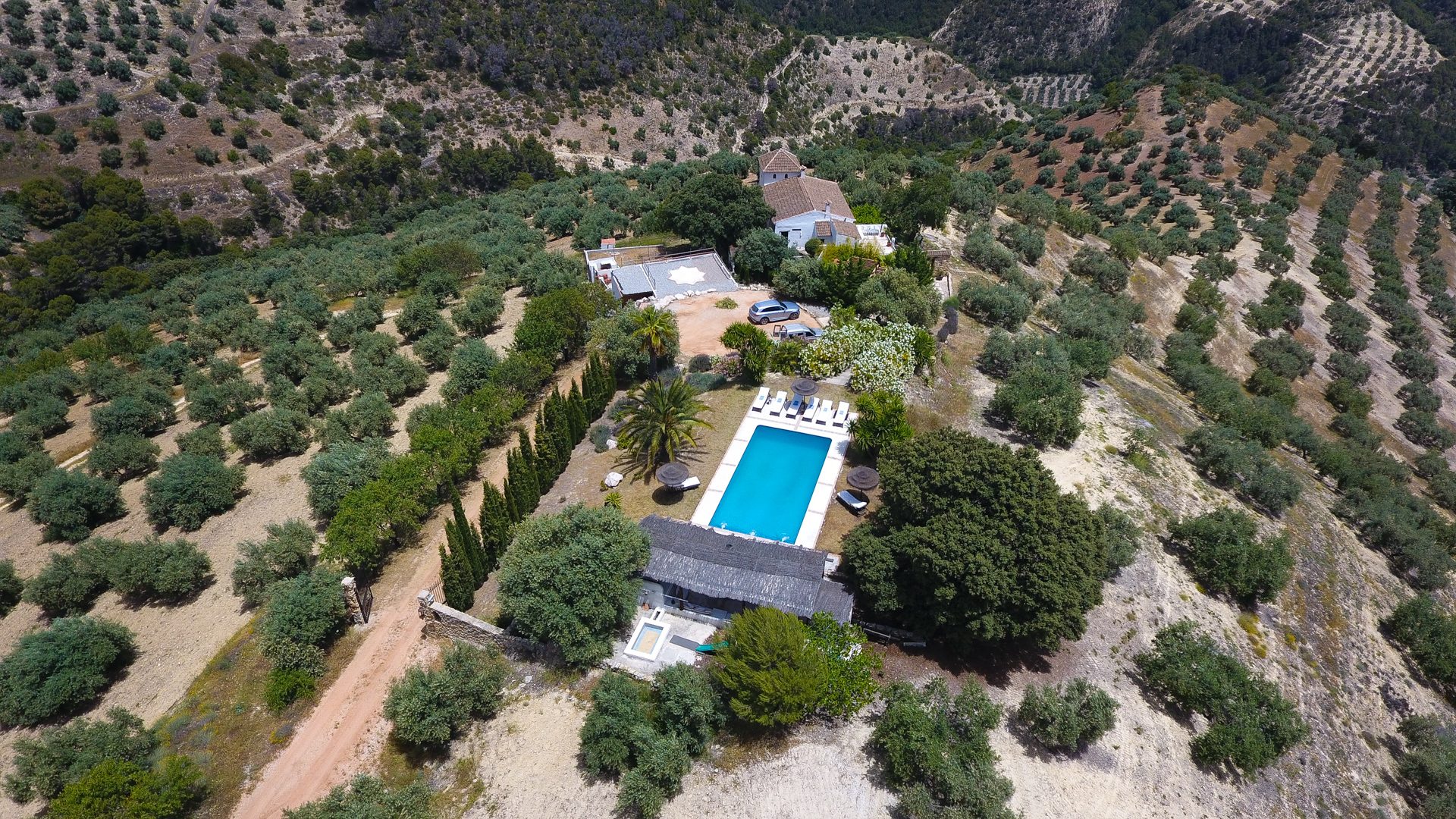
Look out from Cortijo Bujio in almost any direction and you see the same thing: olive trees, in silver-green rows, running to the horizon and up the folds of the hills. This is not scenery — it is the economy, the history and the flavour of the whole region distilled into one tree. The villa sits in the heart of one of Spain's finest olive-oil territories, and understanding what grows around you turns a beautiful view into a story you can taste. Here is that story, in full.

Andalusia produces around 40% of the world's olive oil — more than any country on earth other than Spain itself. The countryside around Montefrío belongs to a protected origin of its own: the Denominación de Origen Protegida (DOP) Poniente de Granada, which covers sixteen municipalities including Montefrío, Algarinejo, Íllora, Moclín, Loja and Alhama de Granada. Within it lie more than 71,000 hectares of olive grove — over half of all the land — worked by around 7,500 families, producing roughly 15,000 tonnes of extra-virgin olive oil in a good year.
That density is why the trees are everywhere you look. It is also why Montefrío regularly hosts the DOP's annual quality awards for the region's best oils: this is not a place that merely grows olives; it is a place that competes over them.
Olives have been pressed in this part of Spain for well over two thousand years. The Phoenicians are credited with bringing cultivated olives to the peninsula; the Romans turned Andalusia (their Baetica) into an industrial oil exporter, shipping amphorae of it to Rome — some of the broken jars still form an artificial hill in the capital, Monte Testaccio.
But the word itself gives away the next chapter. The Spanish for olive, aceituna, and for oil, aceite, both come from Arabic (az-zaytūn, az-zayt) — a linguistic fingerprint of the nearly eight centuries of Moorish Spain. The Muslim farmers of Al-Andalus refined the irrigation, terracing and grove management that still shape these hills. When you drive the lanes around Montefrío, the pattern of the groves is, in part, a medieval inheritance.
Most people think "olive oil" is one thing. In this region it is many. The DOP Poniente de Granada is built on a handful of main varieties, each with its own character:
What makes this corner special is that Montefrío has olive varieties named after the town itself — the Chorreo de Montefrío and the Manzanilla de Montefrío — alongside other rare local types such as the Gordal de Granada and the Nevadillo de Alhama. Few places can say their olives are quite literally local characters. Buying an oil made from these is buying something you genuinely cannot get anywhere else.
Good oil is made in a hurry. The harvest runs roughly from late October to January, and the finest oils come from an early harvest (cosecha temprana) — greener, less ripe olives picked in October and November. They yield less oil, but it is greener, more aromatic and more peppery.
Speed matters after that: the olives are milled within hours, crushed to a paste, and the oil separated by cold extraction (kept below 27°C to preserve aroma and antioxidants). No heat, no chemicals, no refining. The result, if the acidity is below 0.8%, can be called extra virgin — the top grade, and effectively fresh fruit juice. "Virgin" is the next grade down; "olive oil" without the word virgin has been refined and blended, and belongs in a different, plainer category.
Pour a little good extra virgin into a glass, warm it in your hand and taste. You are looking for three things: it should smell grassy or fruity (fresh-cut grass, green tomato, artichoke), taste bitter in the middle of the tongue, and finish peppery — a catch at the back of the throat that can make you cough. That bitterness and pepper are not faults; they are the polyphenols, the antioxidants, and they are the sign of a young, healthy, high-quality oil. In Spain a really peppery oil is affectionately measured in "coughs."
Olive oil has been on a rollercoaster. Drought in 2022–2024 sent prices to historic highs — over €10 per litre on some shelves. Two good harvests and, in Spain, a temporary cut of VAT to zero have brought them back down. In early 2026, everyday supermarket extra virgin runs roughly €4.50–5.00 per litre, with certified organic a little higher, and premium early-harvest and single-estate DOP oils commanding more — often €10–25 for a beautiful 500 ml bottle, which is still a bargain for what it is.
The cheapest place to buy the good stuff is at the source: a local cooperative or almazara (oil mill), where DOP oil is sold at close to producer prices, often direct from the current harvest.
The golden rule: the best oil goes on raw. Drizzle it over a tomato salad, a grilled vegetable, a piece of fish, a bowl of soup — the heat of the plate releases the aroma. Start the day the Andalusian way with tostada con aceite: toasted bread, good oil, a little salt, sometimes rubbed with tomato and garlic.
You can absolutely cook and even fry with extra virgin olive oil — it is far more heat-stable than the myths suggest — but for a very special early-harvest bottle, save it for finishing, where you'll actually taste it. And it isn't only for the kitchen: olive oil has been used for skin, hair and soap around here for centuries.
Because Cortijo Bujio sits inside the DOP, you are minutes from working groves and mills. Many cooperatives and almazaras in and around Montefrío, Íllora and Loja welcome visitors for tours and tastings, especially during and just after the harvest — a chance to watch the milling and taste this year's oil straight from the tank. Pick up a few bottles of single-variety DOP oil to take home; it travels well and makes the best possible souvenir.
For the full experience, book a table at Casa Piolas in nearby Algarinejo, an acclaimed restaurant whose author cuisine is built explicitly around the olive and its oil — the theme of the whole landscape, on a plate. (See our guide to fine dining near Montefrío.)
What kind of olive oil is made around Montefrío?
Extra-virgin olive oil under the DOP Poniente de Granada, made mainly from Hojiblanca, Picual, Picudo and Lucio olives — plus rare local varieties named after Montefrío itself, such as the Chorreo and Manzanilla de Montefrío.
Can you visit an olive mill near the villa?
Yes. Several cooperatives and almazaras around Montefrío, Íllora and Loja offer tours and tastings, best of all during the harvest (roughly November to January).
Why is good olive oil bitter and peppery?
Those qualities come from polyphenols — natural antioxidants — and are the mark of a fresh, high-quality, usually early-harvest oil, not a defect.
How much does good local olive oil cost?
In 2026, everyday extra virgin is around €4.50–5.00 per litre; premium single-estate DOP and early-harvest oils typically €10–25 for a 500 ml bottle. Buying direct from a mill is the best value.
Is Andalusian olive oil really that important?
Andalusia produces about 40% of the entire world's olive oil — the single most important olive-oil region on the planet, and your villa sits right in the middle of it.
---
Cortijo Bujio is surrounded by the DOP Poniente de Granada groves, 15 minutes from Montefrío. Read on about fine dining in the region, eating and drinking around Granada and Montefrío itself.
Sources: DOP Poniente de Granada (doponientedegranada.com); Andalucía Económica / Granada Económica reports on the DOP quality awards in Montefrío; Olive Oil Times and Certified Origins market report (January 2026); Tridge olive-oil price data, Spain, 2026.