الزيتون
Travel guide
History of the olive
History of the olive
The olive tree is one of humanity's oldest companions. Long before it lined the hills of Andalusia, it grew wild along the shores of the eastern Mediterranean, and for six thousand years its silver leaves and golden oil have followed the story of civilisation itself — from Phoenician traders to Roman legions to the gardens of Al-Andalus. To sit among the olives at Cortijo Bujio is to sit inside that history.

The cultivated olive (Olea europaea) descends from a scrubby wild ancestor, the oleaster, still found around the Mediterranean. The best evidence points to domestication in the eastern Mediterranean and the Levant around 4000 BCE — some six thousand years ago — where people first selected trees for larger, oilier fruit and learned to graft them. From there, cultivation spread slowly westward across the sea. (The exact time and place are still debated by scientists, but the Levantine origin is the mainstream view.)
The great carriers were the Phoenicians, master seafarers from what is now Lebanon. Trading across the Mediterranean, they founded Gadir — today's Cádiz — around 1100 BCE, one of the oldest cities in Western Europe, and were active along the Iberian coast through the 11th to 8th centuries BCE. With them came the olive and the knowledge of how to grow it, planted into a land whose climate might have been designed for it. The Greeks, through their own colonies, spread it further. (Andalusia may even have had wild olives exploited locally before this — but the Phoenicians turned it into a crop.)
Under Rome, southern Spain became the province of Baetica, centred on the Guadalquivir valley — roughly modern Andalusia. And Baetica became one of the greatest olive-oil exporters of the ancient world, shipping oil by the shipload to feed the city of Rome and its armies through the state supply system, the annona.
The proof still stands in Rome itself. Monte Testaccio is an artificial hill, some 35 metres high, built almost entirely from the smashed remains of an estimated 53 million olive-oil amphorae — most of them the round Dressel 20 jars of the Guadalquivir. Their stamps name the estates of Baetica. It is, quite literally, a mountain of Andalusian olive oil, and it tells you how central this land already was to the Mediterranean economy two thousand years ago.
After 711 CE, the Arab and Berber rulers of Al-Andalus made the olive their own, refining irrigation, milling and cultivation across the south. Their deepest legacy is in the language: the everyday Spanish words for the fruit and its oil are Arabic. Aceituna, "olive," comes from az-zaytūna; aceite, "oil," from az-zayt. Even the word for an oil mill, almazara, and for the wild olive, acebuche, are Arabic. Every time a Spaniard says "olive oil," they speak a little Arabic. (See our guide to Moorish Andalusia.)
The groves around Cortijo Bujio are the latest chapter of this story. Some Andalusian olive trees are centuries old; the landscape of terraced groves you see today is the direct descendant of Roman latifundia and Moorish orchards. When you drizzle local oil over bread here, you are tasting six thousand years. (See olive oil around Montefrío.)
Where was the olive first cultivated?
Most evidence points to the eastern Mediterranean and the Levant around 4000 BCE, roughly six thousand years ago, from where cultivation spread west across the sea.
Who brought the olive to Spain?
Chiefly the Phoenicians, seafaring traders who founded Cádiz around 1100 BCE and introduced or expanded olive cultivation along the Iberian coast; the Greeks and later the Romans spread it further.
What was Roman Baetica?
The Roman province covering much of modern Andalusia. It was one of antiquity's greatest olive-oil exporters — Rome's Monte Testaccio is a hill built from about 53 million discarded Spanish oil jars.
Why do the Spanish words for olive and oil sound Arabic?
Because they are. Aceituna (olive) and aceite (oil) come from the Arabic az-zaytūna and az-zayt, a legacy of eight centuries of Al-Andalus.
---
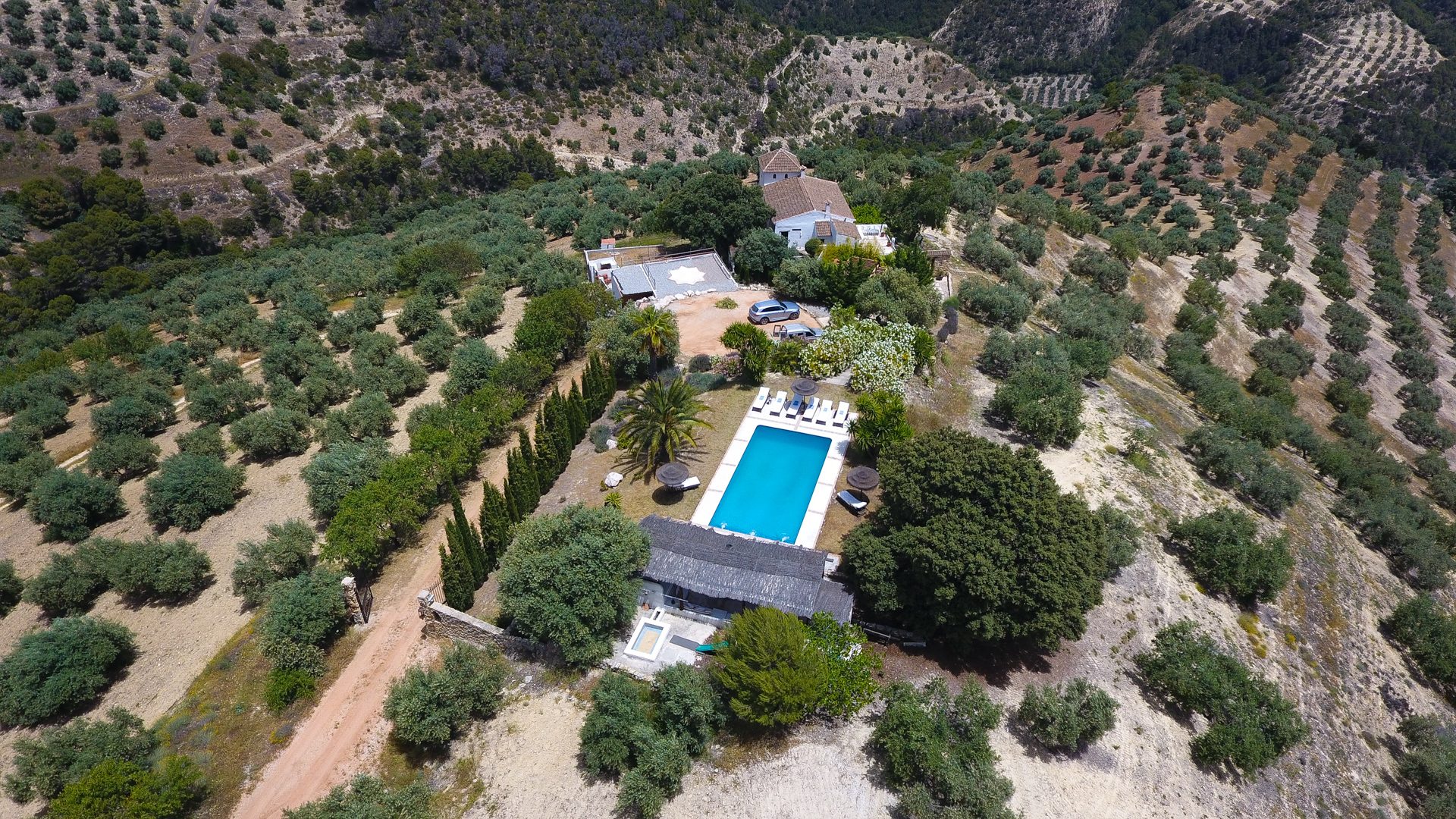
Cortijo Bujio stands among groves with roots in antiquity. Read on: The Great Olive Varieties, The Sea of Olives and Moorish Andalusia.
Sources: Annals of Botany, "On the origins and domestication of the olive"; Wikipedia (Olive; Monte Testaccio); World History Encyclopedia; on Arabic loanwords in Spanish.