الرقص
Travel guide
The Andalusian garden
The Andalusian garden
The greatest art of Al-Andalus was not only carved in stucco or written in verse — it was grown. The Moors of Spain were master gardeners who turned dry hillsides into cool, green, water-threaded paradises, and their vision still shapes the loveliest corners of Granada, from the Generalife to the hidden villa-gardens of the Albaicín. For anyone staying among the olive groves at Cortijo Bujio, understanding the Andalusian garden deepens everything you see.

In Islamic thought, the garden is not mere decoration — it is an image of jannah, paradise itself, promised in the Qur'an as a place of shade, flowing water and endless fruit. The Moors inherited from Persia the idea of the fourfold garden (chahar bagh), divided by four water channels meeting at a central fountain, symbolising the four rivers of paradise. To step into such a garden, out of the heat and dust, was meant to be a small foretaste of heaven — and, in a dry land, water was the most precious luxury of all.
The genius of the Andalusian garden is water — not as spectacle but as presence. Still pools mirror the architecture; narrow channels murmur along the paths; fountains trickle rather than roar. The Moors engineered astonishing systems — like the Alhambra's Acequia Real, carrying water kilometres uphill by gravity alone — so that a garden could be heard before it was seen. Even today, the defining sound of Granada is running water. (See our guide to Granada & the Alhambra.)
The masterpiece is the Generalife, the summer estate of the Nasrid kings above the Alhambra — a place to escape the formality of the court among orchards, cypresses and water. Its Court of the Water Channel runs a long narrow pool between arcs of fountains, and the sound of moving water never stops. Laid out in the 13th and 14th centuries, it feels startlingly serene and modern still — perhaps the most perfect garden in Europe.
The Moorish garden survived the conquest in a very Granadan form: the carmen. From the Arabic karm ("vine"), a carmen is a walled town house with its own private garden and orchard, hidden behind a high wall in the steep lanes of the Albaicín. Behind those plain walls lie terraced gardens of roses, jasmine, orange and fig, with a fountain and a view of the Alhambra across the valley — private paradises, exactly as the Moors intended, still lived in today.
What makes an Andalusian garden special?
Its Islamic roots: the garden as an image of paradise, built around water — still pools, channels and fountains — with shade, scent and fruit, engineered to feel cool and serene in a hot, dry land.
What is the Generalife?
The summer garden-palace of the Nasrid kings above the Alhambra, with its famous Court of the Water Channel — one of the finest surviving Islamic gardens in the world.
What is a carmen?
A traditional Granada house with a walled private garden, from the Arabic karm ("vine"), hidden in the lanes of the Albaicín — a living descendant of the Moorish garden.
Can I visit these gardens?
Yes — the Generalife with your Alhambra ticket, and certain cármenes such as the Carmen de los Mártires, about 45–60 minutes from Cortijo Bujio.
---
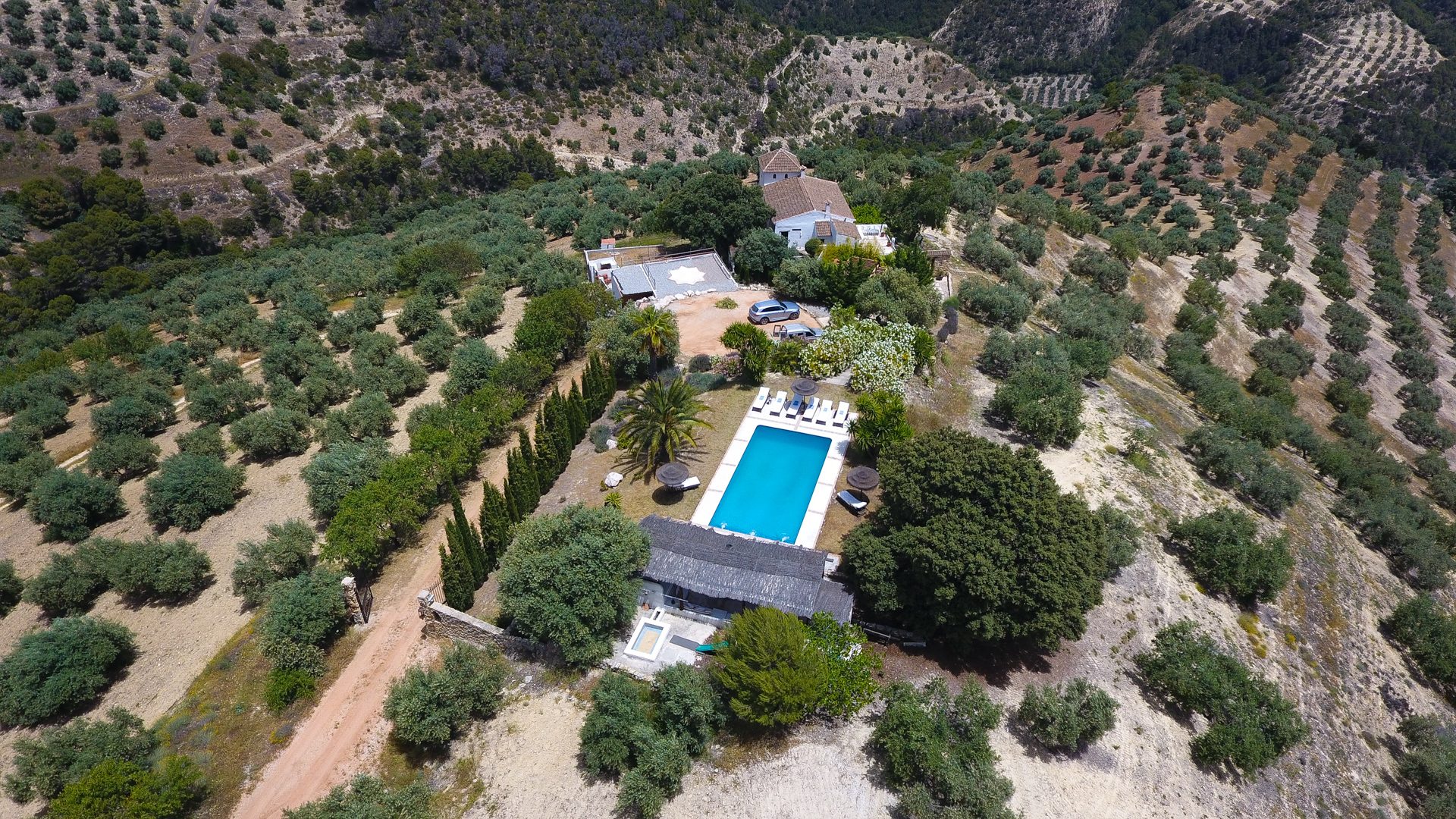
Cortijo Bujio keeps its own green refuge among the olives. Read on about Granada & the Alhambra, olive oil and Moorish Andalusia.
Sources: D. Fairchild Ruggles, Gardens, Landscape, and Vision in the Palaces of Islamic Spain; Patronato de la Alhambra y Generalife; on the cármenes of the Albaicín.