التاريخ
Travel guide
El Cid & history
El Cid & history
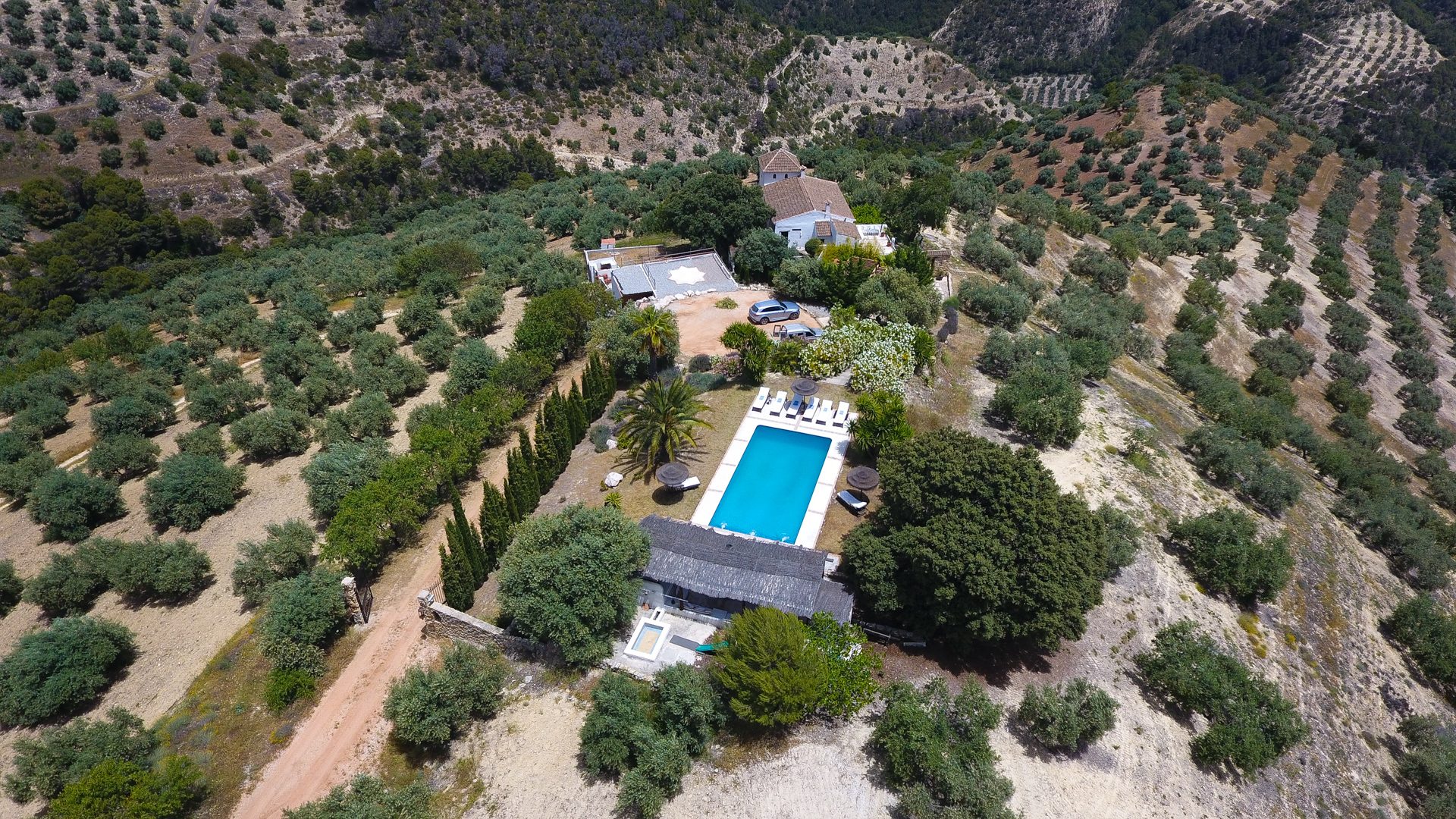
The hills around Cortijo Bujio look peaceful now, but for centuries they were a war zone — the actual, shifting border between Christian and Muslim Spain. The castle on the rock at Montefrío, the ruined fortress at Íllora, the stronghold at Moclín: these were frontier posts, and the frontier moved back and forth across this landscape for the better part of five hundred years. No single life captures that strange, violent, endlessly negotiated world better than one man's — Rodrigo Díaz de Vivar, El Cid. This is the long history of Andalusia told through the age he embodied.

Andalusia has been coveted for three thousand years. The Phoenicians founded trading colonies on its coast around 1100 BC; the semi-legendary kingdom of Tartessos grew rich here on silver and copper. Then came Rome, which made this its province of Baetica — one of the wealthiest in the empire, exporting olive oil, wine and grain, and giving Rome two emperors, Trajan and Hadrian. When Rome fell, the Visigoths ruled a Christian Hispania from Toledo. And then, in a single generation, everything changed.
In 711 AD a Muslim army crossed from North Africa and, within a few years, overran almost the whole peninsula. The land they created — Al-Andalus — would endure in some form until 1492, nearly eight centuries. By the 10th century, the Caliphate of Córdoba was arguably the most advanced state in Europe, with running water, street lighting and one of the world's great libraries. (For that story in full, see our guide to Moorish Andalusia.) But golden ages end. In 1031 the Caliphate shattered — and out of its wreckage came the world that made El Cid.
After 1031, Al-Andalus fragmented into a patchwork of small, rich, quarrelsome kingdoms called taifas — Seville, Granada, Zaragoza, Toledo, Valencia and more. They were cultured and wealthy but militarily weak, and they survived largely by paying parias: protection money, in gold, to the stronger Christian kingdoms of the north.
This produced one of the most fascinating and least romantic periods in Spanish history. Loyalty was for sale. Christian kings took Muslim gold, and Muslim kings hired Christian armies; alliances crossed the religious line constantly. A soldier of genius could sell his sword to the highest bidder, Muslim or Christian, and carve out his own power. Into exactly this world rode El Cid.
His real name was Rodrigo (Ruy) Díaz, born around 1043 in the village of Vivar near Burgos, in Castile. The title he earned in his own lifetime says everything about his world: El Cid comes from the Arabic al-sīd, "the lord" — a name given to him with respect by Muslims as much as Christians. His other name, El Campeador, means "the Champion." Raised at the royal court in the household of the future King Sancho II, he became the finest soldier of his age — and served, at different times, both the cross and the crescent.
El Cid's story runs straight through this region. In 1079, King Alfonso VI of León-Castile sent him south to Seville to collect the parias owed by its Muslim ruler. While he was there, the taifa of Granada — its army stiffened by rival Castilian nobles, including El Cid's great enemy García Ordóñez — attacked Seville. El Cid defended the city and, at the Battle of Cabra (near Córdoba, barely an hour from where you are staying), routed the forces of Emir Abdullah of Granada, capturing García Ordóñez himself.
It was a brilliant victory — and it ruined him. Alfonso VI, jealous and ill-advised, was enraged that El Cid had campaigned into Granada without royal authority, and exiled him. The greatest soldier in Spain was cast out by his own king.
In exile, El Cid did what the age allowed: he sold his sword. For years he served the Muslim taifa of Zaragoza, fighting its wars loyally and brilliantly — a Christian warlord in the pay of a Muslim king. Then he set his sights higher. Over several campaigns he besieged and, in June 1094, took the great city of Valencia, and ruled it as his own princedom — neither purely for Castile nor for any Muslim master, but for himself.
El Cid died in Valencia on 10 July 1099, defending it against the fanatical new power sweeping up from Africa, the Almoravids. His remarkable wife, Jimena, held the city for three more years before it finally fell to the Almoravids in 1102; his body was eventually laid to rest in Burgos Cathedral, where it lies today.
Then legend took over. Around 1200, an anonymous poet composed the Cantar de mio Cid — the oldest surviving Castilian epic and Spain's national poem — which turned the frontier mercenary into an ideal of loyalty and honour. Later chronicles (and the famous 1961 Hollywood film) added the unforgettable tale that his corpse was strapped upright to his warhorse Babieca and ridden out of the gates to terrify the enemy into flight. That story is legend, not history — but it tells you how completely this one man captured the imagination of a nation. The real El Cid was more interesting than the myth: not a crusader, but a supremely capable survivor of an age with no fixed sides.
The Almoravids who killed El Cid's dream, and the Almohads who followed them, were stricter, harsher regimes that briefly reunited Al-Andalus by force. But the balance was shifting north. In 1212, a combined Christian army shattered Almohad power at Las Navas de Tolosa, in the mountains north of here. After that the great cities fell in a rush: Córdoba in 1236, Seville in 1248. In one of history's sharpest ironies, the man who helped the Christians take Seville was Muhammad I ibn al-Ahmar, the founder of the last Muslim kingdom — Granada — buying his own survival with a rival's defeat. (That is the paradox at the heart of the Alhambra.)
For 250 more years, the Nasrid Kingdom of Granada held on as the last Muslim state in Spain, and its northern border ran right through this landscape. The whitewashed castle villages near the villa were the front line of that long stand-off: Montefrío, its castle-church built on the old Nasrid fortress and taken by Christian forces in 1486; Íllora, called "the right eye of Granada" for its watchtower; Moclín, guarding the mountain pass. When you climb to any of these ruins, you are standing on the very edge of the two worlds El Cid moved between — four centuries after him, at the frontier's final chapter. In 1492, Granada surrendered, and Al-Andalus was over.
Who was El Cid, really?
Rodrigo Díaz de Vivar (c. 1043–1099), a Castilian nobleman and the most celebrated soldier of medieval Spain. Nicknamed El Cid (from Arabic al-sīd, "the lord") and El Campeador ("the Champion"), he fought for both Christian and Muslim rulers and ended his life as the independent lord of Valencia.
Did El Cid really fight near Granada?
Yes. At the Battle of Cabra in 1079, near Córdoba (about an hour from Cortijo Bujio), he defeated the army of Emir Abdullah of Granada while defending Seville — a victory that led directly to his exile.
Was El Cid a hero or a mercenary?
Both, depending on who is telling the story. The epic Cantar de mio Cid made him a national hero of loyalty and honour; the historical record shows a brilliant frontier warlord who served Muslim and Christian masters alike. That ambiguity is exactly what makes him fascinating.
Is the story of his corpse on horseback true?
No — that is a later legend, popularised by medieval chronicles and the 1961 film. El Cid died in Valencia in 1099; the dramatic ride-out is myth, not history.
Where is El Cid buried?
In Burgos Cathedral in northern Castile, alongside his wife Jimena.
---
The countryside around Cortijo Bujio was a frontier for five centuries. Read on about Moorish Andalusia, Granada & the Alhambra and Montefrío's frontier castle.
Sources: Encyclopædia Britannica, "El Cid"; the Cantar de mio Cid (c. 1200); Richard Fletcher, The Quest for El Cid; Brian A. Catlos, Kingdoms of Faith: A New History of Islamic Spain; Camino del Cid Consortium (caminodelcid.org).