المناظر
Travel guide
Day trips
Day trips
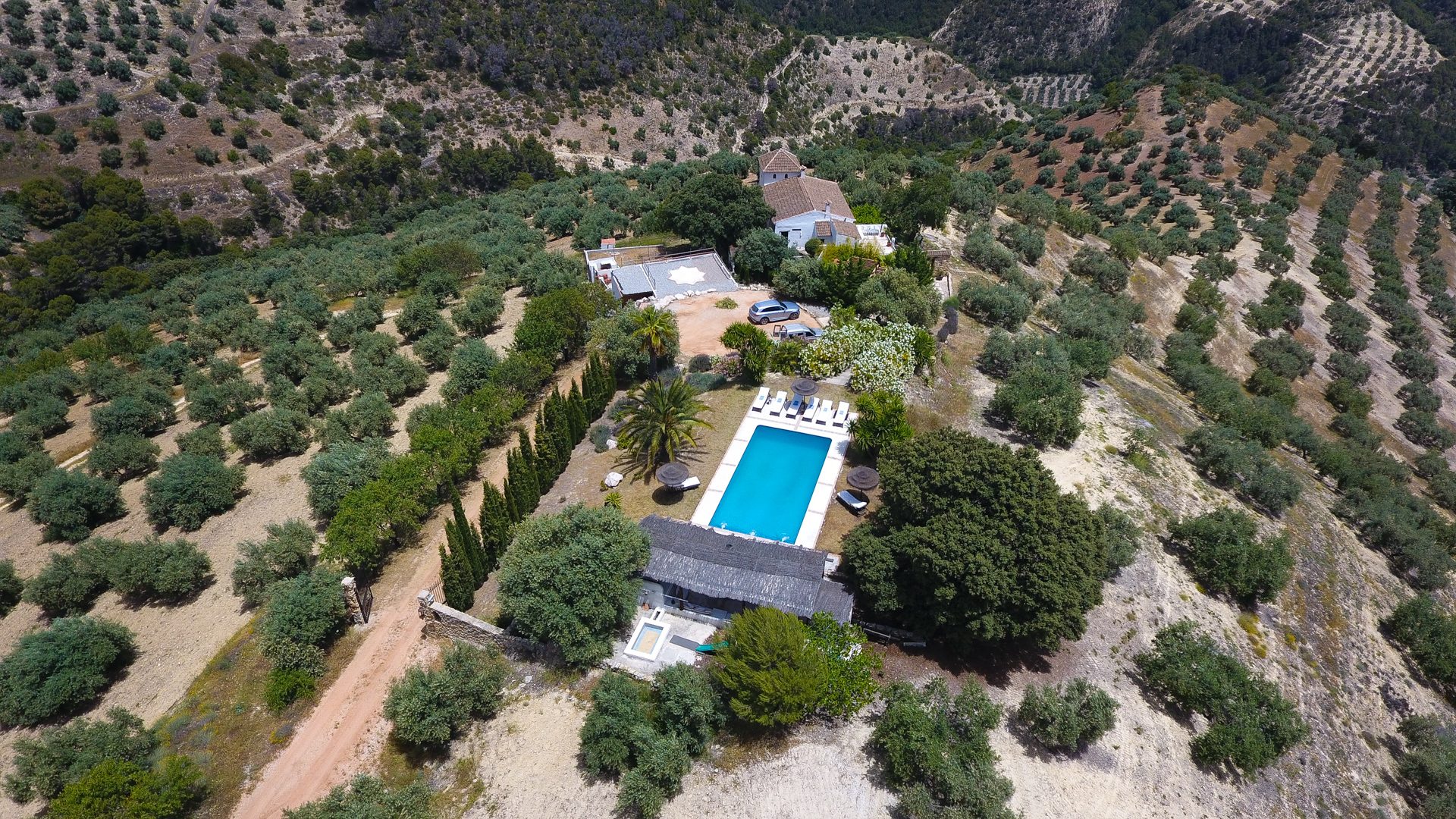
One of the quiet luxuries of Cortijo Bujio is its position. The villa sits in deep countryside, yet within a couple of hours' drive lie three of the greatest monuments of Islamic Spain, mainland Spain's highest mountain and a subtropical coastline where mangoes grow. You can spend a week here without repeating a day. Here are the trips worth planning around, roughly in order of distance.

The obvious one, and rightly so. The Alhambra, the Albaicín and the free-tapas bars of the old city make Granada an unmissable day out. Because you are based in the hills, you sidestep the city's parking headaches: drive in, spend the day and return to silence. Book Alhambra tickets well ahead — the Nasrid Palaces run on strictly enforced timed slots that sell out weeks in advance in high season. (See our full Granada & the Alhambra guide.)
A spectacular and under-visited town built on the edge of a deep gorge — the tajo — with a river running far below. Its very name tells its story: Alhama comes from the Arabic al-hamma, "the hot springs," and the thermal baths just outside town have been used since Roman and Moorish times. It is a wonderful half-day: a dramatic cliff-top old quarter, a gorge walk and warm mineral water to soak in afterwards.
Close to home, two frontier villages guard the old border of the Kingdom of Granada. Íllora was called "the right eye of Granada" for its strategic castle; Moclín sits below a hilltop fortress and is famous for the pilgrimage of El Cristo del Paño. Both give you the Reconquista landscape without the crowds — ruined ramparts, big views and villages that see few foreign visitors.
Worth the drive for one building alone. The Mezquita-Catedral, the Great Mosque-Cathedral of Córdoba, was begun in 785 by Abd al-Rahman I and expanded over two centuries into one of the largest and most beautiful mosques in the world. Its prayer hall is a forest of columns — 856 of them survive today, of jasper, marble, granite and porphyry — carrying the famous red-and-white double arches that seem to march away in every direction.
Its history has a twist. After the Christian conquest, a Renaissance cathedral was built directly into the middle of the mosque in the 16th century. Emperor Charles V, who had approved the works, is reported to have regretted it on seeing the result, telling the clergy that they had destroyed something unique to build something ordinary. Whether or not he really said it, the building today is exactly that collision — a cathedral growing out of the heart of a mosque, unlike anywhere else on earth.
Nearby lie the ruins of Medina Azahara, the fabulous palace-city built by Abd al-Rahman III in the 10th century as the capital of the Caliphate — and sacked and abandoned barely 70 years after it was finished, a whole royal city that vanished into legend until archaeologists rediscovered it. Córdoba also gave the world two of the greatest medieval minds: the Muslim philosopher Averroes (Ibn Rushd) and the Jewish philosopher Maimonides, both born here.
Mainland Spain's highest mountains, and full of superlatives. Mulhacén, at 3,479 metres, is the highest peak on the Iberian Peninsula. The ski resort is the southernmost in Europe and one of the sunniest — it typically runs from December into late April. Its most famous boast is real: from here you can, on the right spring day, ski in the morning and swim in the Mediterranean in the afternoon, with the coast little more than an hour away.
In the warmer months the same range offers superb walking, especially in Las Alpujarras, the string of white villages — Pampaneira, Bubión, Capileira — clinging to the southern slopes. They are threaded by acequias, irrigation channels first dug by the region's Moorish farmers and still carrying snowmelt to the terraces a thousand years later. The village of Trevélez, one of the highest in Spain, is famous for its air-cured mountain ham.
Granada has a coastline, and it is unlike the rest of Spain's. Sheltered by the Sierra Nevada, the Costa Tropical around Almuñécar and Salobreña enjoys a genuinely subtropical microclimate — warm enough that local farmers grow mango, avocado and cherimoya (custard apple), crops you will not find on any other European mainland coast. Expect small coves, dark-sand beaches, seafront chiringuitos grilling the day's catch and far fewer crowds than the Costa del Sol next door.
For lovers of architecture, Priego de Córdoba is a jewel — a small town of extravagant Baroque churches and fountains, set in the Subbética hills amid some of the finest olive groves in Spain. It pairs beautifully with a tasting at one of the local oil mills.
A sensible rhythm from the villa: one big monument day (Granada or Córdoba), one mountain or coast day, one slow local day around Montefrío and its castle villages — with plenty of time left for the pool. Ask us and we will help you sequence it around the weather and the Alhambra booking window.
What is the best day trip from Cortijo Bujio?
Granada and the Alhambra, just 45–60 minutes away, is the standout. Córdoba's Mezquita (under two hours) is worth a full day, and the Sierra Nevada and Costa Tropical (each around 90 minutes) offer mountains and beaches in the same trip.
Can you really ski and swim in the same day near Granada?
Yes. On a spring day you can ski at the Sierra Nevada resort in the morning — Europe's southernmost — and reach the Mediterranean beaches of the Costa Tropical, a little over an hour away, by the afternoon.
How far is Córdoba from the villa?
Under two hours by car, making the Mezquita-Catedral and Medina Azahara a comfortable, if full, day trip.
Do I need a car at Cortijo Bujio?
Yes — the villa is set in the countryside, and a car is essential for reaching Montefrío, Granada and the wider region. It also lets you enjoy the best of rural Andalusia at your own pace.
---
Cortijo Bujio's setting in the hills above Montefrío puts monuments, mountains and coast all within reach of a single base. Explore our guides to Granada, Montefrío and the history that shaped this landscape.